 ES
ES
 EN
EN
 FR
FR


Sell to the Argentine and regional market
A market of more than 46 million digitized consumers, with high adoption of e-commerce and digital payment methods — and entire categories with pent-up demand after years of import restrictions.
Why E-Commerce in Argentina?
The Argentine consumer is urban, educated, and receptive to international brands. The opening of imports has reopened the market for products that for years had a limited supply: those who arrive first with a competitive product find a niche that doesn't exist in mature markets. And from Argentina, their operations gain preferential access to Mercosur.
Argentina E-Commerce Market Size and Share Analysis: Growth Trends and Forecast (2026-2031)

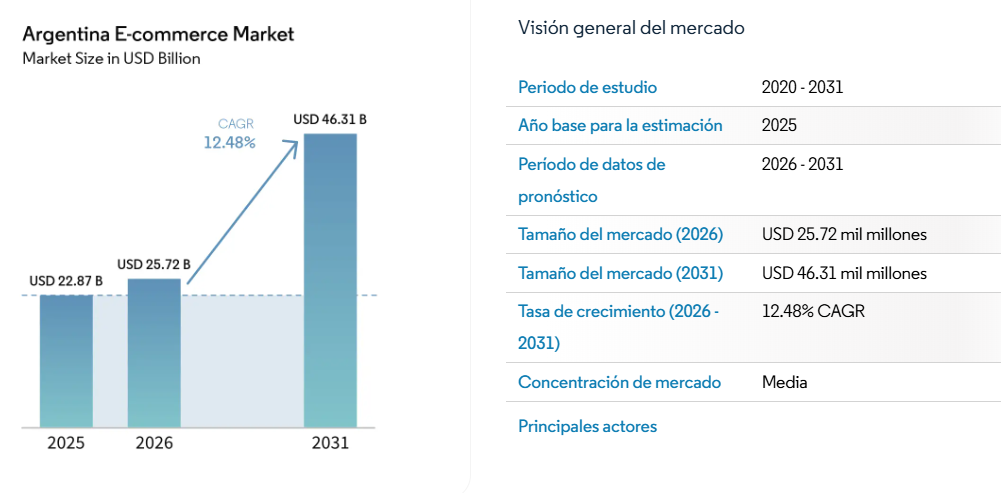
Argentina's e-commerce market report is segmented by business model (B2C, B2B), device type (smartphone/mobile, desktop and laptop computers, other device types), payment method (credit/debit cards, digital wallets, BNPL, other payment methods), and B2C product category (beauty and personal care, consumer electronics, fashion and apparel, food and beverages, among others). Market forecasts are expressed in value (USD).
Argentina E-Commerce Market Analysis by Mordor Intelligence
Argentina's e-commerce market is expected to grow from USD 22.87 million in 2025 to USD 25.72 million in 2026, and is projected to reach USD 46.31 million by 2031, at a compound annual growth rate (CAGR) of 12.48% between 2026 and 2031. The elimination of capital controls and the increase in courier service limits by the Milei government are reducing cross-border friction and expanding product availability. Mobile purchases already account for two-thirds of transactions, and same-day delivery coverage in Buenos Aires and Córdoba now reaches 75% of orders, which has notably boosted conversion rates.[1] MercadoLibre Investor Relations, “2025 Global Emerging Markets Presentation,” investor.mercadolibre.com. Digital wallets are connecting consumers who previously relied on cash, while installment plans are increasing average basket value by more than a third. Logistics investment is shifting from the capital to secondary cities, but poor road quality in the north and northeast still inflates reverse logistics costs. Competitive intensity is rising as Amazon, Rappi, and TikTok Shop expand their local operations, but Mercado Libre's integrated commerce, payments, and logistics cycle continues to anchor the Argentine e-commerce market.
Peso Devaluation: Foreign Consumers' Search for Bargains
A 54% peso adjustment in December 2023 positioned Argentine products as global bargains, triggering a surge in foreign orders for electronics, footwear, and digital services. The removal of most capital controls in April 2025 simplified currency settlement and brought a new generation of international sellers into the Argentine e-commerce market. The narrowing gap between official and parallel exchange rates is reducing currency risk, and cross-border volumes through courier channels doubled in the first quarter. While currency effects gradually normalize, this short-term boost constitutes the main driver of the projected growth.
Fintech "Installment" Payment Plans Expand Average Basket Value
National interest in deferred payments runs deep, but platform-level integration of 3-to-12-month installment plans now embeds financing directly at checkout. Merchants report a 35-45% increase in ticket size and a significant reduction in cart abandonment. Mercado Pago, MODO, and bank wallets manage real-time approval decisions, while BNPL specialists extend credit to consumers with limited credit history. Growing adoption beyond Buenos Aires is expected to drive medium-term growth as economic stabilization reduces default risk and speeds up regulatory approval of new credit products.
Same-Day Delivery Networks in Buenos Aires and Córdoba Improve Reliability
Investment in urban micro-hubs and AI-based fleet routing raised the on-time delivery rate from 30% in 2023 to 75% in 2025. This improvement addresses a persistent trust gap that previously discouraged high-frequency digital grocery orders. Logistics providers now offer guaranteed 24-hour coverage for 80% of AMBA SKUs, and funding rounds for last-mile startups aim to extend similar service levels to Mendoza and Rosario.
Micro-Import Duty Exemptions Boost Cross-Border Orders
The Door-to-Door framework allows 12 tax-free imports per year for packages up to USD 50 and now exempts shipments worth up to USD 400 from duties. The relaxation of weight limits and faster customs clearance streamline delivery by private courier companies and have driven an increase in the entry of low-value fashion, cosmetics, and leisure items into the country. The regulatory incentive applies at the start of the process, hence the driver's short duration.
Segment Analysis
By Business Model: B2B Digitalization Drives the Next Wave of Growth
The B2C segment controlled 87.62% of Argentina's e-commerce market in 2025, driven by market leaders and high internet penetration. In contrast, B2B revenue is projected to grow at a compound annual growth rate (CAGR) of 15.6%, pushing its share of the Argentine market from single digits to a significant portion by 2031. Mandatory e-invoicing and VAT transparency rules, which took effect in 2025, are driving online purchases, while SMEs adopt digitally integrated sourcing portals that shorten delivery times and reduce administrative costs. Platform providers are adding credit terms, wholesale pricing, and ERP connectors tailored to distributors and manufacturers. Mercado Libre Business and Tiendanube Empresas target buyers in Argentina's e-commerce industry with catalog management tools, and Pagos de Argentina Financiamiento offers payment terms of up to 90 days. Government promotion of supply chain digitalization through the MiPyME initiative further reinforces its adoption among the country's 1.1 million small businesses.
How do we support you in this sector?
- Incorporation of your company to operate e-commerce in Argentina.
- Tax registrations and tax framework for digital operations.
- Requirements for importing your products.
- Opening accounts and local payment methods.
- Logistics and operational structure for your sales channel.
- Ongoing accounting, tax and administrative support.
E-Commerce · Argentina
His store, selling to the Argentinian market..
Tell us about your project and we'll respond within 24 business hours with concrete steps to get started.
Let's talk about your project